
Project Description
Project Name: Stepping Up with OASIS: Opening Access to Science Instruction and Support
Project Timeline: 2021 – 2026
Funder: Department of Education, Office of Special Education Programs (OSEP) Stepping Up Technology Implementation
Partners: Evaluator: Evergreen Evaluation Consultants, School District: Alief Independent School District, Houston, TX
The OASIS project built the capacity of coaches and teachers to implement effective science instruction for all learners through a scalable coaching platform harnessing UDL principles. OASIS worked to provide open research, strategies, and tools for elementary science coaches and teachers to support every learner in active science learning and sensemaking.
The OASIS project utilized co-design and iterative feedback cycles over the course of two pilot studies to refine the materials, resources, and coaching program.
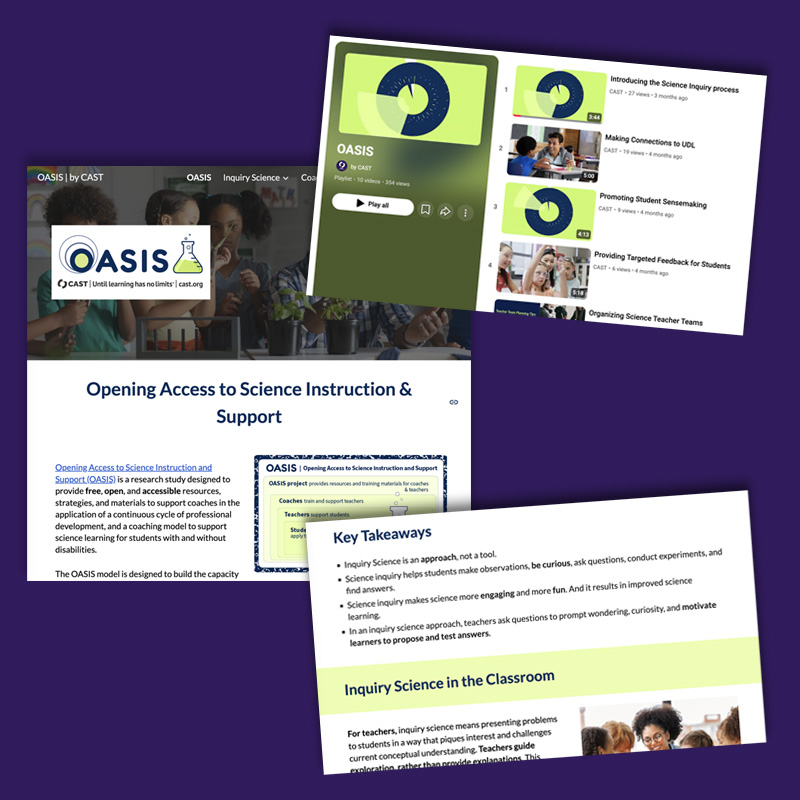
OASIS Coaching Platform
The OASIS coaching platform is a freely available website offering tips, resources, inspiration, and UDL moves to coaches and teachers.
Impact Study Highlights
The OASIS impact study included 5 treatment school sites across 4 states and 2 control schools. Six coaches, 10 teachers, and over 350 students with and without disabilities participated. Data collection included pre- and post-surveys, observations of coaching sessions, interviews, and student science notebook artifacts and test data.
If your goal as a coach or science specialist is to engage in reflective, evidence-based conversations that support meaningful shifts in instruction and student outcomes, OASIS is a valuable tool worth recommending.
Coaches reported enhanced coaching practices. 100% of coaches surveyed would recommend OASIS to other coaches.
Teachers indicated increases in their skills and knowledge. Between pre- and post-testing, treatment teachers on average reported increases in:
- Science teaching efficacy beliefs (75% -> 81% agreement)
- Skill in supporting all students (17% -> 83% extensive skill)
- Knowledge of scaffolds for sensemaking (17% -> 67% extensive knowledge)
Students had positive attitudes towards science, such as 87% in agreement that “my teacher helps me understand Big Science Ideas” and 90% positive scores on Computer Efficacy.
Analysis described a positive trend for growth on student standardized test scores in the treatment group. Confounding variables limit conclusions from these data, but the impact is worth exploring in future studies.
- 100% of coaches would recommend OASIS
- 87% of students agree “my teacher helps me understand Big Science Ideas”
- 90% of students report positive Computer Efficacy
Project Leadership
- Co-Principal Investigator: Jenna Gravel
- Co-Principal Investigator: Shauntā Singer
- Project Manager: Katie Bevan
Contact
For more information about this project, please email oasis@cast.org.
Coaching connections

More about OASIS
History of SNUDLE


Related articles

