Introduction
The OASIS project (Opening Access to Science Instruction and Support), funded by a Stepping Up grant from the Office of Special Education Programs (OSEP), supports elementary science learning by building the capacity of coaches and teachers to support every student. By integrating inquiry-based science instruction with Universal Design for Learning (UDL), coaches and teachers can anticipate and reduce barriers to science learning and sensemaking. During the impact year of the study, CAST worked directly with coaches to provide research, strategies, and tools, with participating coaches reporting positive impacts on their coaching practices.
OASIS by the Numbers
- 6 participating coaches
- 100% found OASIS high-quality, relevant, and useful
- 100% would recommend OASIS
Opportunity
Inquiry-based science places student curiosity, discovery, and sensemaking at the center of learning. Students ask questions, gather evidence, and develop explanations to build new understanding. Designing these experiences with learner variability in mind helps reduce barriers to meaningful participation in science. Prior CAST work supported accessible inquiry science through a universally designed digital science notebook, SNUDLE.
The OASIS project extends the student-facing work to explore how instructional coaching can amplify positive coaching and teaching practices such as recognizing barriers, designing supports, and creating opportunities for all students to participate. The OASIS coaching cycle provides a structured framework for helping coaches and teachers collaboratively design, implement, and reflect on inquiry-based learning experiences.
In addition to working directly with coaches across five treatment sites, the OASIS project developed resources and materials that can be applied in multiple contexts and are freely available to any coaches and teachers.
Process: Building Coaching Capacity
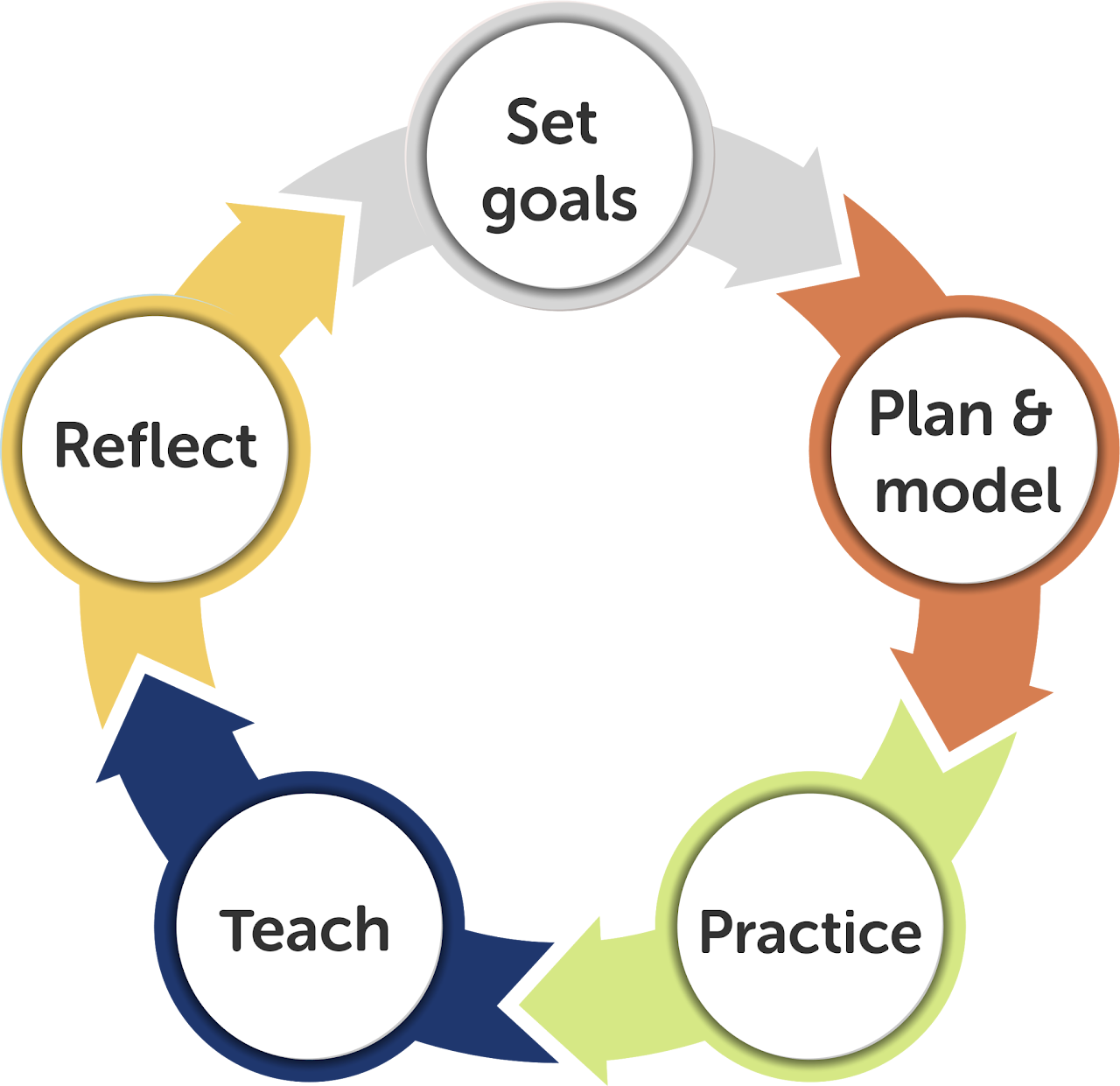 The OASIS coaching cycle is an adaptive 5-step cycle that guides collaborative problem-solving and planning among coaches and teachers. This iterative cycle supports the development of coach-teacher partnerships while planning, delivering, and reflecting on inquiry-based science activities.
- Set goals
- Plan & model
- Practice
- Teach
- Reflect
This coaching cycle emphasizes collaboration, intentionality, reflection, and continuous improvement.
The OASIS project additionally developed a coaching platform with freely available resources. These coaching and instructional resources were developed through co-design processes that incorporated the needs and perspectives of science coaches and teachers. The OASIS coaching platform includes research-based resources, strategies, and materials. Highlights include a video series, inspiration and resources, and coaching tips for each phase of an inquiry approach. The platform also spotlights “UDL Moves” that are relevant to the coaching tips, highlighting applications of Universal Design for Learning.
The OASIS website was intentionally designed through a UDL lens to reduce barriers and increase access to the content. In terms of multiple means of engagement, educators can choose from an array of materials and select resources that feel authentic and relevant to their goals and contexts. In terms of multiple means of representation, educators can access content through text, images, and video. Accessibility features are embedded, including image descriptions and captioning for videos. Finally, in terms of multiple means of action and expression, the resources available can support educators to set goals, anticipate and plan for challenges, and reflect on their progress.
“Participating in the OASIS program had a significant impact on my coaching practices by encouraging a more structured, reflective, and data-informed approach to coaching.” Participating OASIS coach

UDL Move
UDL Consideration 6.1: Set meaningful goals
The OASIS coaching cycle leads with setting goals. When coaches and teachers set goals, they can plan together, assess progress, and work on continuous improvement.
Results
While working with coaches during the impact study, we collected feedback and information in multiple ways, including pre/post surveys, open reflections, structured interviews, and observations of coaching sessions.
Observations of coaching sessions were supported by the Coaching Observation Checklist (Brussow et al., 2013), which highlights strong coaching practices in structure, content, communication, and overall efficacy of coaching sessions. Participating coaches had strengths in asking open-ended questions, seeking clarity, and brainstorming solutions. Evaluators rated all observed coaching sessions as high efficacy.
On post-surveys after OASIS participation, 90% of coaches had positive assessments of their own knowledge and skills in supporting all students, reducing science barriers, creating scaffolds for sensemaking, and using accessibility features. A majority of coaches reported using activities such as identifying best practices, collaboration, and goal-setting.
During reflections and interviews, coaches reported positive impacts on their own coaching practice, such as making them more aware, reflective, and structured.
It pushed me to be more intentional and structured in coaching conversations instead of relying on informal feedback or instincts alone.
My participation allowed me to be more intentional in my coaching in terms of providing feedback, asking guiding questions, and providing resources and support as requested.
They also noted changes in teachers, including increases in confidence, lesson planning, progress monitoring, and reflective teaching. These enhanced teaching practices ultimately had a positive impact on student experiences as well.
OASIS resources, including SNUDLE, had a positive impact on teachers in science classrooms by supporting instructional planning, enhancing pedagogical practices, and promoting reflective teaching. These resources provided structured, accessible tools that aligned curriculum objectives with effective teaching strategies specific to science education.
OASIS resources, including SNUDLE, had a positive impact on students in science classrooms by enhancing engagement, supporting understanding of scientific concepts, and promoting greater ownership of learning.
100% of coaches agreed that they would recommend OASIS to other coaches and would like to work with CAST again.
More to take UDL & Coaching to the Next Level

Related articles