Imagine starting a race…
Everyone begins at the same starting line. But as the race begins, someone places weights around your ankles. You try to keep up, but reaching the finish line is much harder than it should be.
That is how Makenzie, a high school student with dyslexia, described learning without the assistive technology (AT) accommodations and supports she needed. At times, she felt that using assistive technology were seen as “cheating” rather than support. “Without my accommodations, it is like having a weighted jacket on me, or like wearing weights,” she explained. “Obviously, I’m not going to run as fast as people without the weights.”
As a student with dyslexia, she often struggled to process and understand written text, making it difficult to fully access the learning materials and keep up with peers. “All the words were there… but I don’t understand what’s going on,” she explained when describing what reading once felt like. Timed reading activities and traditional approaches sometimes left her feeling frustrated and singled out. What was at stake was not only her academic success, but confidence in her ability to learn.
How Makenzie’s journey began with advocacy & assistive technology
Makenzie’s journey toward more accessible learning developed gradually with support from her family, flexible teaching, and AT.
Her mother, an educator, played a significant role as her first advocate. When academics were not progressing, she pushed for accommodations for her daughter. Over time, Makenzie’s IEP included supports that made school more manageable. It started simply with highlighting important information. Even that small adjustment made a difference and enabled her to identify what needed extra explanation.
Tools opened access. People made it possible.
A real turning point came when Makenzie discovered audiobooks. Simply changing the way information was presented opened the door to learning materials that had previously felt out of reach. As her confidence grew, she began pairing printed books with audio, highlighting key ideas and taking notes as she read and listened. This combination helped her make stronger connections between concepts and deepen her understanding. Text-to-speech tools provided an additional layer of support, giving Makenzie an independent way to access digital text whenever she needed it.
 On her own, she also began to discover how she learns best – and that, according to her teacher Ms. Stoeffler, is ultimately the goal: “to help students find the way that their brain works.” Makenzie did exactly that. She realized that using graph paper made her handwriting more organized and easier to read by keeping spacing in order. When writing essays, speech-to-text tools came in handy by helping with spelling and punctuation, allowing her to focus more on getting ideas out rather than getting stuck on mechanics.
Even as Makenzie became more confident, new challenges started to emerge. Geometry felt especially difficult, partly because of its abstract concepts and highly specific vocabulary. As she explained, “colors help”, offering another way to organize and make sense of information. For example, she used different colors to organize information, and Ms. Stoeffler offered physical shapes to manipulate instead of relying only on written explanations. Makenzie’s experience reflects a core idea of the CITES Framework: meaningful access often begins with collaboration among families, educators, and support teams to identify and remove barriers to learning.
Assistive technology matters, but so does community
Rather than relying on one approach, many teachers offered multiple ways for Makenzie to access and engage with content, reflecting the Universal Design for Learning (UDL) Framework’s emphasis on designing flexible pathways for learner variability. Through visuals, acted-out scenes from literature, and alternative ways to access the curriculum, teachers provided multiple means of representation and engagement. In English class, acting out scenes from Macbeth helped make difficult texts feel more understandable and engaging. Being a “big picture person,” as Makenzie describes herself, these approaches made learning more meaningful and her learning more successful. This flexibility also reflected the mindset of her principal, Mr. Walbaum, who explained, “there are many ways to approach one problem. And there might be multiple solutions.”
“There are many ways to approach one problem. And there might be multiple solutions.” Dan Walbaum, Principal
Over time, Makenzie grew academically and gained confidence in advocating for herself. Although AT and extra support sometimes made her feel different, especially when she had to leave class and peers saw this as unusual or unfair, supportive relationships and environments helped her view the tools as strengths. Adults that viewed AT as access rather than a stigma empowered her to embrace these accommodations that enabled her to learn and thrive. Feeling understood, connected, and accepted were key factors that helped her feel confident using the AT accommodations that supported her learning.
Relationships are key in confidence & growth
Part of that growth came through relationships. During middle school, one teacher played an especially important role in helping Makenzie feel understood and more comfortable. They met regularly to talk through challenges and reflect on successes and areas of need. At first, the teacher accompanied Makenzie to conversations with other teachers, helping to explain what supports she needed and modeling how to speak up and ask questions. What started as guided support gradually became confidence in understanding and how to communicate her own needs. Whether it was asking for a quieter testing environment, relying on visuals, or speaking up when certain technologies did not function as expected Makenzie started to thrive. As Principal Walbaum reflected, he most admired her “ability to advocate not only for herself, but for others with dyslexia as well.”
With the right supports and people, Makenzie’s race was no longer defined by the weight she carried, but by the confidence and access that helped her move forward.
From individual accommodations to inclusive technology systems
Makenzie’s story shows that accommodations, flexible teaching, and self-advocacy were supported by a broader culture of collaboration. Principal Walbaum described leaders and teachers working together at Greenfield Central on grading, mastery, services, and learner variability, while principals across schools shared ideas and mentored new teachers into that access-focused culture.
At the classroom level, this mindset came through in the way educators responded to students’ needs. Her teacher, Mrs. Stoeffler, noted that student struggle can too easily be misread as lack of effort, when it may actually signal the need for a different kind of support. She adapted materials, used evolving technologies and accessibility practices, and kept asking a simple question: if one way is not working, what is another way to teach it? At Greenfield Central, that flexibility helped shift the focus from providing accommodations to removing barriers so more students could access learning in ways that worked for them.
As new cell phone restrictions are implemented, schools face new challenges. Mrs. Stoeffler reflected that while phones can be a distraction for some students, they are essential access tools for others who rely on text-to-speech or other supports. As Greenfield Central prepares to navigate these new policies during the school day, she acknowledged that staff would need to continue finding ways to ensure students do not lose access to tools that support learning. In Makenzie’s story, inclusion depended not on one tool or one accommodation, but on a school community willing to listen, adapt, and protect access.
Takeaways
- Assistive technology works best as part of an inclusive technology ecosystem. Makenzie’s growth was not the result of one tool alone, but of coordinated support from family, teachers, school leaders, flexible instruction, and accessible learning options.
- Access is personal, flexible, and often includes both high-tech and low-tech supports. Audiobooks, text-to-speech, speech-to-text, graph paper, colors, visuals, manipulatives, and quieter spaces all helped Makenzie learn in ways that matched how she processed information.
- Student confidence grows when support is paired with belonging and self-advocacy. When adults listened, reduced stigma, and helped Makenzie understand what worked for her, she became more confident using accommodations and advocating for herself and others.
AT is not “cheating”
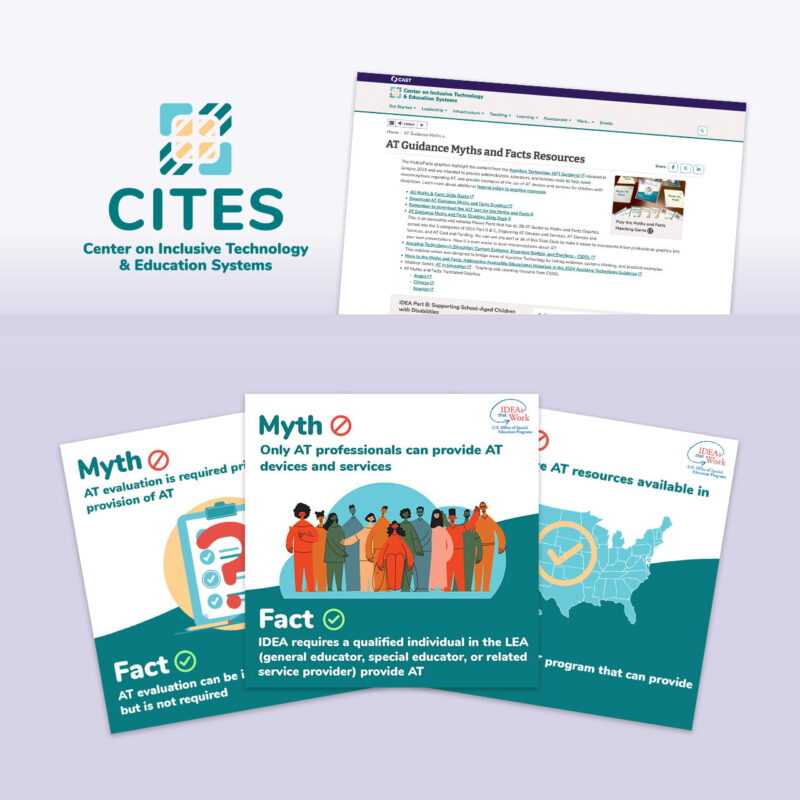
AT is not “cheating,” AT does not have to be high-tech, and should be considered as part of access to Free and Appropriate Public Education (FAPE) when needed—not as an optional extra. The Myths & Facts graphics summarize the federal Assistive Technology (AT) Guidance released in January 2024. They equip administrators, educators, and families with tools to dispel misconceptions about AT and offer examples of its usage for children with disabilities.
Resources to help you lead the way with assistive technology
Related articles