Ceremony Remarks: Honoring Dr. George Van Horn
Delivered by CAST Board Chair, Shelley Berman on October 1, 2026 in Louisville, Kentucky
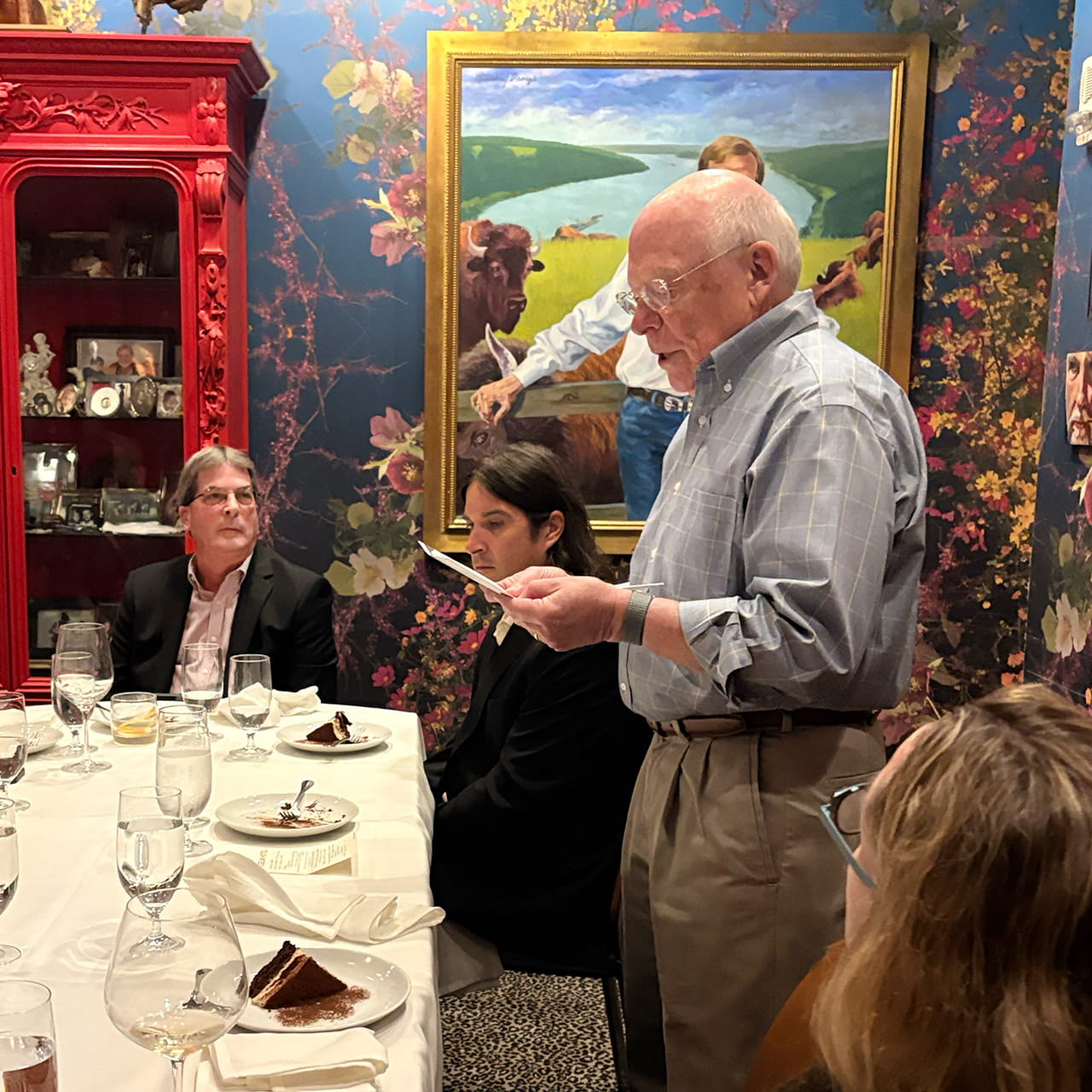
Good evening, everyone.
It is a real honor to be here tonight on behalf of CAST and our Board of Directors to present the inaugural UDL Lifetime Achievement Award.
Before we recognize tonight’s recipient, I want to say a little about why we created this award.
The UDL Lifetime Achievement Award is intended to recognize something that is bigger than a single accomplishment, project, publication, or moment. It honors a professional life marked by a sustained commitment to Universal Design for Learning—and to the belief that when we design learning differently, we can create more equitable, inclusive, and powerful opportunities for every learner.
UDL has always been about more than a set of strategies. At its heart, it asks us to look differently at learner variability. Instead of asking, “What is wrong with this learner?” or “How do we accommodate this student?” UDL asks us to examine the design of the learning environment itself.
Where are the barriers?
What are the goals?
What options can we provide?
And how can we design learning so that more students can access it, engage with it, and demonstrate what they know from the very beginning?
That sounds simple.
Making it real—across classrooms, schools, and entire systems—is anything but simple.
That is why this award matters.
We are recognizing people whose careers have helped move UDL from an idea into practice; from a framework into a way of working; and from individual classrooms into systems that can sustain change over time.
And there is perhaps no more fitting person to receive the very first UDL Lifetime Achievement Award than Dr. George Van Horn.
George’s career is remarkable in its breadth. He has been a teacher, principal, superintendent, special education leader, university faculty member, researcher, mentor, and advocate. But what stands out most is the consistency of the question that seems to have guided his work:
How do we build systems that allow every learner to succeed?
At Bartholomew Consolidated School Corporation in Indiana, George helped lead a transformation that has become one of the most compelling examples of districtwide UDL implementation.
BCSC began its UDL journey nearly two decades ago. And importantly, George did not approach UDL as something that belonged to special education.
In fact, one of the defining ideas in his work was that what benefits students with disabilities should not be separated from what benefits everyone else.
The district was already committed to inclusion. George and his colleagues recognized that the next step was not simply adding more services around students—it was improving the core learning environment itself.
That distinction is incredibly important.
UDL became a framework for thinking about curriculum and instruction across the district, for all students.
And George understood that this kind of change required more than asking teachers to adopt a new practice. It required changing systems, building capacity, creating partnerships, and giving educators the support and time to rethink their practice.
At BCSC, UDL became a way to align initiatives rather than add another initiative.
It became a common language.
It influenced professional learning, coaching, curriculum, technology, inclusion, and ultimately the culture of the district.
And the results were significant.
Over the years of implementation, BCSC saw meaningful improvements in student outcomes across groups, including students with disabilities, students receiving free and reduced-price lunch, African American students, and Hispanic students. The district also achieved remarkably high rates of inclusion, with the vast majority of students with disabilities spending most of their time in general education. (AASA)
But when you look at George’s reflections on this work, the numbers are not actually the most interesting part.
What mattered to him was the change in how educators thought.
Teachers who initially wondered whether UDL was simply another initiative began to see it as a lens for understanding their students and improving their teaching.
They became more willing to experiment.
More willing to provide options.
More willing to identify and remove barriers.
And more focused on what students were actually trying to learn rather than on whether every student could demonstrate that learning in exactly the same way.
George gave a powerful example of this in discussing assessment: if the goal is for a student to demonstrate understanding of the causes of the Civil War, requiring an essay may unintentionally turn that into two assessments—one of the student’s understanding of history and another of the student’s ability to write an essay.
The question becomes: Are we measuring what we actually intend to measure? (Education Week)
That is UDL thinking at its best.
And George didn’t just talk about it.
He built the conditions for other people to do it.
He understood that sustainable change is a team sport. His work at BCSC involved deep partnerships—with teachers, administrators, the teachers’ association, CAST, researchers, UDL practitioners, and others. As George has said, implementing UDL is not a journey you want to take by yourself. (Loui Lord Nelson)
That spirit of partnership has also made George an important part of the broader UDL community.
He has shared BCSC’s story nationally and internationally. He has contributed to the research and implementation conversation. He has mentored and encouraged educators and leaders. And he has continued to collaborate with CAST and others long after UDL became established at BCSC.
More recently, George even helped CAST share lessons from that experience through Project COOL, offering administrators a practical example of how UDL can help align multiple initiatives and create coherence rather than fragmentation. (CAST)
That may be one of the most important parts of George’s legacy.
He showed us that UDL is not something that has to sit alongside the rest of the work.
It can help organize the work.
It can help leaders ask better questions.
It can help teachers see learner variability as expected rather than exceptional.
And it can help students understand themselves as capable, strategic, resourceful learners.
George’s influence has extended far beyond one district or one generation of educators. His work helped contribute to a broader national conversation about UDL at a time when the framework was gaining recognition in federal education policy, including its inclusion in the Every Student Succeeds Act. (Education Week)
And perhaps most importantly, George has never treated UDL as a destination.
His career reminds us that UDL is a commitment to continuously asking:
Who is being left out?
Where are the barriers?
What can we redesign?
And how can we create the conditions for more learners to thrive?
That is why George is such a fitting recipient for this first award.
Because a lifetime achievement is not simply measured by how long someone has worked.
It is measured by what changed because they were there.
Because George was there, thousands of educators had a different way to think about teaching and learning.
Because George was there, students who might once have been separated from the general education experience had greater access to it.
Because George was there, an entire school system demonstrated that UDL could move from theory to practice—and from practice to lasting systems change.
And because George was willing to share what BCSC learned—the successes, the challenges, the missteps, and the persistence required—countless other educators and leaders have been able to learn from that journey.
So, George, on behalf of CAST, our Board of Directors, and the broader UDL community:
Thank you.
Thank you for your leadership.
Thank you for your persistence.
Thank you for your willingness to experiment, to partner, and to keep asking better questions.
And thank you for helping all of us see what is possible when we stop designing education around an imagined “average” learner and start designing for the incredible variability that is actually present in every classroom.
It is my great honor to present Dr. George Van Horn with the inaugural UDL Lifetime Achievement Award.
George, please join me.
Read the full Announcement:
A Long, Strange Trip: Honoring George Van Horn’s Lasting Impact on UDL and Inclusive Learning
Related UDL Resources