Introduction
CAST’s Circle Up project, funded by the U.S. Dept. of Educations Education and Innovation in Research (EIR) grant program, is designing and testing a comprehensive school model for promoting student engagement by integrating academic, social, and emotional learning to support learner agency and teachers’ use of Universal Design for Learning to identify and minimize barriers.
The team at CAST behind Circle Up have worked with educators at Bussey Elementary School in Aldine Independent School District in Houston, Texas throughout the 2023-24 school year to help translate research into practice, learn from the wisdom of practitioners, and develop impactful classroom tools, routines, and resources that can be used by both teachers and students. This design year produced numerous options that went on to launch in pilot schools the following school year for further study. Educators involved felt they made significant contributions to a design process that could make a positive impact on students.
Opportunity
Students are stronger learners when they are behaviorally, affectively, and cognitively engaged. At Bussey Elementary, educators noted difficulties with motivation, participation, and behavior. The co-design process aimed to address these and other challenges with student engagement by promoting learning that is meaningful, resilient, and strategic. Design challenges revolved around these three themes: ignite your passion for learning, see challenges as opportunities for growth, and be strategic about reaching learning goals.
Process: Collaborative Design Cycles
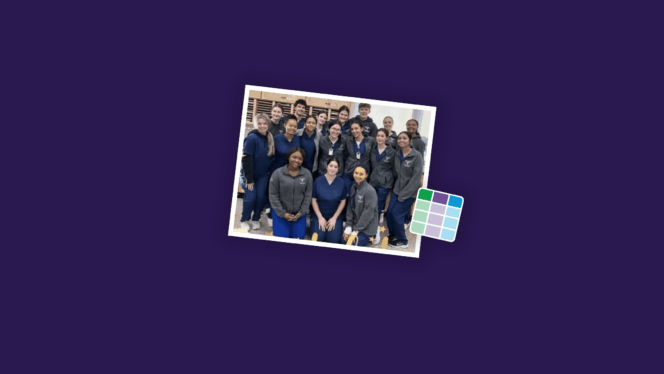
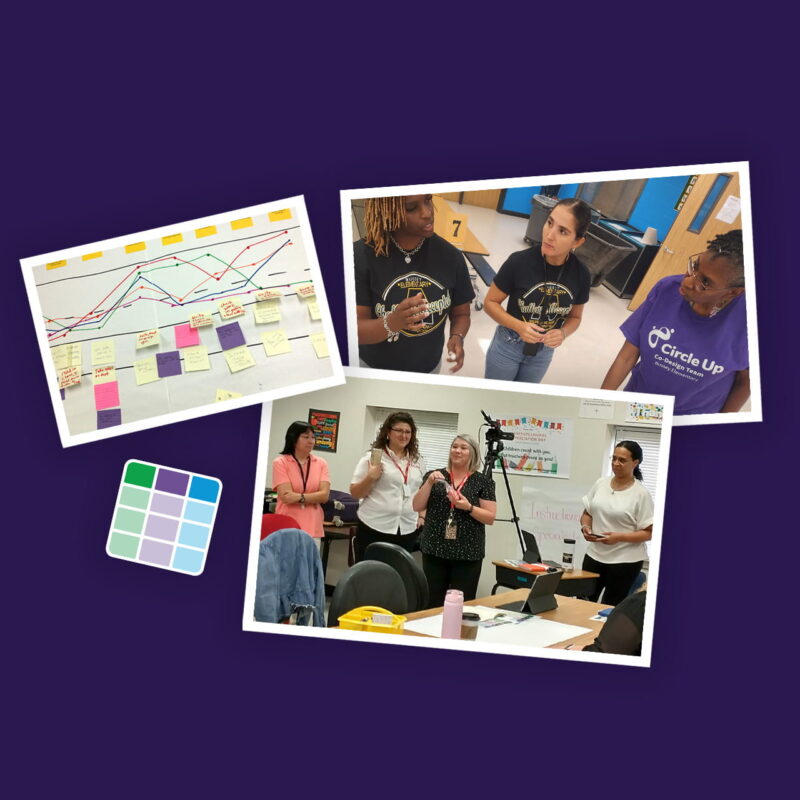
The co-design team included representation from classroom and inclusion teachers, instructional specialists, administrators, counselors, district curriculum supervisors, and district special education managers. The team met 10 times over the course of the school year, with each session focusing on a new “design challenge” related to the Circle Up themes.
A co-design session began with an introduction that included the learning goal, research reminders, and an opportunity to share current practices. Next, the group moved on to brainstorming in the form of “how might we …”. Examples included “how might we support students to identify and manage productive emotions?” and “how might we set students up to embrace a challenge?”.
By the Numbers
- 10 co-design sessions
- 16 prototypes developed
- 93% of educators felt they made significant contributions to designs
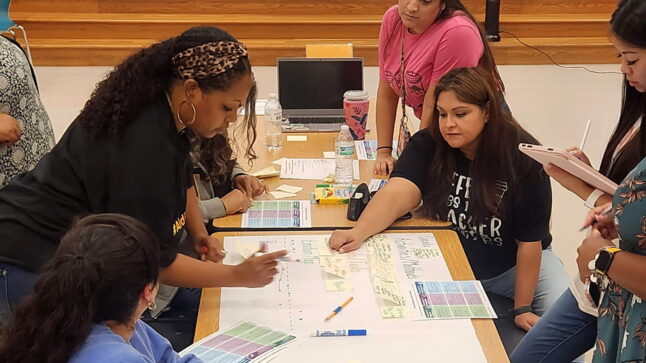
After the initial brainstorm, the team grouped and sorted the ideas to find themes before moving into developing sample prototypes in small groups. The prototypes went through an iterative design process, using dot voting on features, revising the originals, and then sharing out. After these pieces of the co-design process, the CAST design team created a finished prototype and brought it back to a subsequent design session. Teachers then had the opportunity to try out the tools and routines in their classroom settings, leading to another feedback and design cycle.
The Value of Co-Design
Bussey educators, including inclusion teacher Andrea Fambro, 4th grade teachers Myrna Puac and Edith Chavez, and principal Kathy Scott, find value in the participation and collaboration embedded in the Circle Up co-design process.
“I’m really pleased to have been part of creating the Circle-Up program, as I believe it will significantly support the whole child by addressing obstacles that impact a student’s learning.” Educator, Aldine Independent School District
UDL Move
UDL Consideration 8.3: Foster collaboration, interdependence, and collective learning
The co-design team members held a variety of roles, including teacher, coach, administrator, designer, and researcher. Emphasizing the value of each perspective helped foster collaboration and collective learning as teams worked together to meet the co-design challenges.
Results
By the end of the design year, the co-design team had created 16 prototypes that addressed the three Circle Up themes from different directions. With the help of classroom feedback and reflection, these were narrowed down and launched in two pilot schools in the 24-25 school year. Data from the pilot year helped further refine tools that are currently being implemented in an impact study across six schools.
Co-design was an essential part of making the Circle Up components usable and useful in actual classrooms. Educators found value in the collaborative environment, and over 90% of participating educators responded that they were able to make significant contributions to the design process.
More on the power of SEL + UDL
Related articles